2.jpeg)
Hongbao Ru Ware
📍 Ruzhou, Henan
Wang Zhenfang (b. 1969) is a National Arts and Crafts Master, provincial-level representative inheritor of the national intangible cultural heritage of Ru ware firing techniques, Senior Engineer, Senior Arts and Crafts Specialist, and Senior Appraiser of Ancient Ceramics.
Master Wang’s work has received over a hundred awards, including the Gold Prize at the First National Exhibition of the Five Great Song-Dynasty Kilns, the Grand Prize at the Minlong Cup National Ceramics Competition, the Henan Arts and Crafts Treasures Award, and the Gold Prize at the Henan Star Design Competition. Her piece Global Fortune was designated as a head-of-state-level national gift for the 2010 Shanghai World Expo and presented to leaders from around the world. In 2011, her work Harmony Vase of China was hailed as a “symbol of Central Plains culture.” Both Harmony Vase of China and Baifu Stone, Noble Dragon Vessel, and Noble Dragon Vase were selected as official provincial gifts and presented to distinguished guests by Henan provincial leadership. In 2012, her jade-quality porcelain tea set series was named the annual high-level diplomatic gift by a consortium of 32 overseas Chinese media organizations including Hong Kong Wen Wei Po and International Daily News.
Master Wang’s creations have been collected by hundreds of prominent figures across politics, culture, and the arts—including former Vice Chairmen of the Chinese People’s Political Consultative Conference, former Chief Executives of Hong Kong and Macao, and former heads of state of Japan and South Korea—as well as by institutions such as the British Museum of Treasures, the Thai Senate, the China Welfare Foundation, and the Taipei City Government.
Elegant Tea Set
This set draws on the refined aesthetics of the Song dynasty. Its glaze evokes the celebrated “sky-blue after rain” hue of Ru ware, capturing the ethereal calm of Song-era ceramics. The forms are pared back—a rounded teapot, a gentle fairness pitcher, and dainty tasting cups—retaining classical elegance while meeting the practical needs of a modern tea table. With use, tea gradually seeps into the crackle lines, creating golden traces known as “gold-thread markings”—a patina that records the quiet passage of time and makes every piece uniquely personal. From look to touch, the guiding spirit is “serene refinement”: an invitation to slow down and savor the unhurried poetry that Song dynasty literati brought to everyday life.
Elegant Tea Set
Meiping Vase
This piece features the classic meiping silhouette—broad shoulders, a narrow waist, a slender base, a small mouth, a short neck, and a ring foot—with fluid, graceful lines. The body displays diagonal crackle patterns accompanied by delicate cicada-wing textures, and an antique-style glaze lends the whole vessel a timeless elegance. Originally a wine container, the meiping’s narrow mouth also makes it a charming vessel for a single branch of blossoms. First appearing in the Tang dynasty and gaining popularity during the Song, this form was produced at kilns across China and has remained one of the most beloved shapes in the history of Chinese ceramics through the Yuan, Ming, and Qing dynasties to the present day.
Harmony Vase – Slim Neck Lotus Mouth Vase
The piece is crafted using the hand-throwing technique and is inspired by the lotus, one of China’s top ten famous flowers. The word “lotus” (荷) is a homophone for “harmony” (和), “union” (合), and “cooperation” (合作), symbolizing peace, harmony, collaboration, mutual success, unity, and integration, conveying heartfelt blessings to the world. The mouth of the vessel resembles a blooming lotus, while the body is graceful and restrained, featuring smooth, elegant lines. It is entirely glazed in the precious Ru ware sky-blue glaze, characterized by its pure and gentle hue, reminiscent of jade-like luster. The interplay between the glaze and the delicate crackle pattern enhances its ethereal beauty, showcasing exquisite craftsmanship. This piece seamlessly integrates Ru ware culture with traditional Chinese heritage.
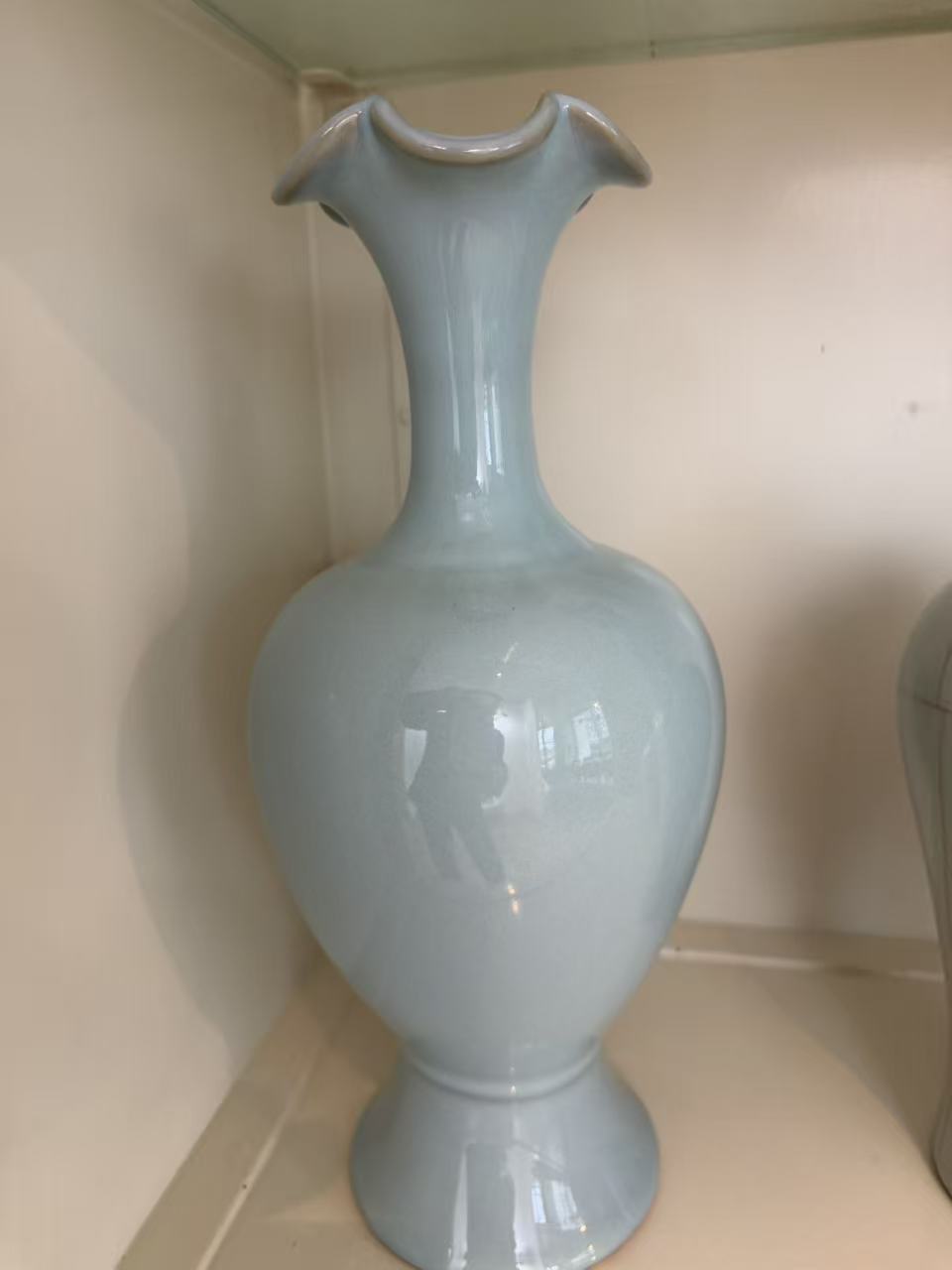
Harmony Vase