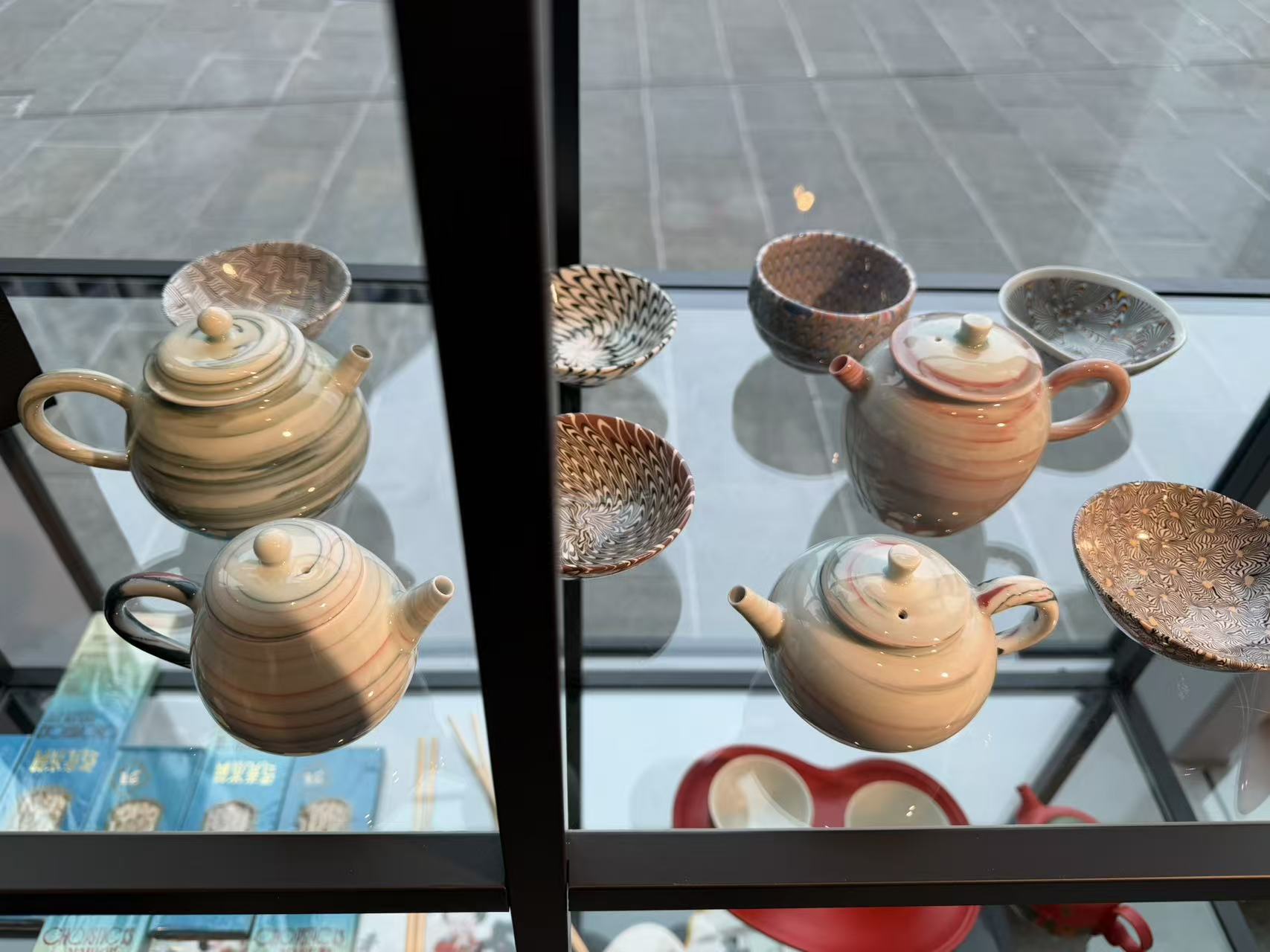
Jingu Xuan Marbled Porcelain
📍 Henan
Marbled porcelain, an ancient ceramic technique, was born during the Tang Dynasty and reached its artistic pinnacle at the Dangyangyu Kiln in Jiaozuo during the Northern Song Dynasty. It broke the traditional boundary of the separation between body and glaze, perfectly marrying the suppleness of clay with the fierce intensity of fire. However, as the Jurchen Jin army swept south, the fires of the Dangyangyu Kilns were tragically extinguished. For nearly a millennium, this complex craft remained buried in the dust of history, which was a profound loss to the world of ceramics.
The most soul-stirring feature of Jingu Xuan Marbled Porcelain is that it is consistent from the inside out. Unlike the surface-level painting of Blue and White or Famille Rose porcelain, the patterns of marbled porcelain are formed by alternating layers of different-colored clays, meticulously folded and kneaded together. These patterns are not mere surface decorations but are integrated into the very bone of the piece. No matter how you slice it, the internal grain remains identical to the exterior. This unique trait earned it the title of “The Gentleman’s Porcelain,” symbolising a person of integrity who is as noble on the inside as they appear on the outside.
Creating a single piece of Jingu Xuan Marbled Porcelain requires 108 meticulous steps. In the mixing and texturing phase, artisans must master the varying shrinkage rates of different clays. Through techniques like weaving and layering, they pre-set intricate patterns—such as feathers, braids, or wood grain—deep within the clay block. During forming, marbled porcelain cannot be shaped haphazardly on a potter’s wheel, as a single slip of the hand can distort the dense internal patterns. Finally, during firing at temperatures of 1300°C, even the slightest difference in the expansion coefficients of the colored clays can cause the piece to shatter. Behind every masterpiece lies a staggering failure rate; it truly is one in a hundred.
The soul of Jingu Xuan is Chai Zhanzhu, a National-Level Representative Heritage Successor. A widely told story recounts his journey in the 1980s: faced with a lost art, Chai locked himself in a primitive kiln. To crack the secret of the clay formulas, he reportedly tasted the various muds of the Taihang Mountains and endured tens of thousands of failed firings. Once, an entire kiln of painstakingly crafted pieces emerged completely shattered. While others urged him to quit, he found a single shard among the ruins—a fragment bearing a texture as fluid and ethereal as a feather. Driven by this obsessive craftsmanship, he finally resurrected the lost Dangyangyu technique in 2002 and founded Jingu Xuan.
The “Chinese Dragon” is a hallmark of Jingu Xuan. It ingeniously utilises marbled textures to simulate the tactile quality of dragon scales and the ethereal flow of auspicious clouds. This dynamic piece has even been featured in national art textbooks. Another masterpiece, “Peacock Displaying Plumage,” employs the high-difficulty feather grain technique to capture the intricate elegance of a peacock’s feathers. It is now part of the permanent collection at the National Museum of China.
Jingu Xuan Marbled Porcelain is more than just exquisite ware; it is a milestone in the history of Chinese ceramics. It fuses the natural beauty of the earth with the precision of human ingenuity, showcasing the resilience of China’s intangible cultural heritage. It teaches us that a true classic, even after a thousand years of darkness, can be reborn through the fire and dazzle the world once more—as long as there is a craftsman’s heart to guard it.