Xiangzhou Kiln
📍 Anyang, Henan
During the Northern Dynasties, the Anyang area was part of Ye. After the Eastern Wei and Northern Qi dynasties moved their capital to Yecheng, the region became the political, economic, and cultural center of northern China. In 580 CE, the Sui general Yang Jian suppressed a rebellion, burned Yecheng, and forcibly relocated its administrative centers and inhabitants south to the city of Anyang. Consequently, Anyang rose as a major hub in northern Henan and southern Hebei. This is reflected in archaeology by the discovery of numerous Northern Qi and Sui tombs around Anyang (including Xiaotun Village), which have yielded large quantities of glazed pottery, early celadon, and white porcelain. Determining the source kilns for these ceramics was a long-standing puzzle.
Several late Northern Dynasties to Sui dynasty kiln sites have been found in the region. In 1974, a significant kiln site was discovered on the south bank of the Huan River near Anyang Bridge. Excavations revealed a relatively complete kiln and over 400 artifacts, including kiln furniture, porcelain, and burial objects (mingqi) like fragments of celadon figurines. Unrecorded in history, it was initially called the “Anyang Kiln.” Later, because Anyang was historically known as Xiangzhou and a porcelain model from a nearby Sui tomb bore an incised “Xiang” character, it was renamed the Xiangzhou Kiln.
Four excavations since 1974 have established that the kiln began in the late Northern Dynasties, flourished in the Sui dynasty, and declined in the early Tang. It produced both celadon and pioneering white porcelain, becoming the region’s most significant, productive, and advanced kiln complex.
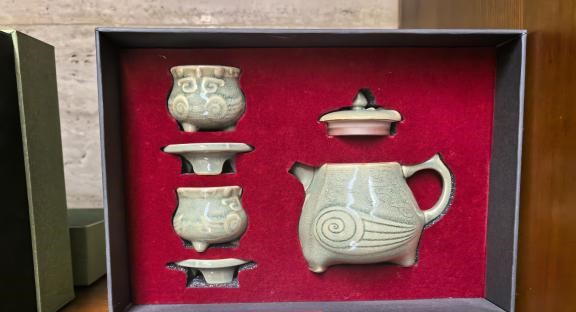
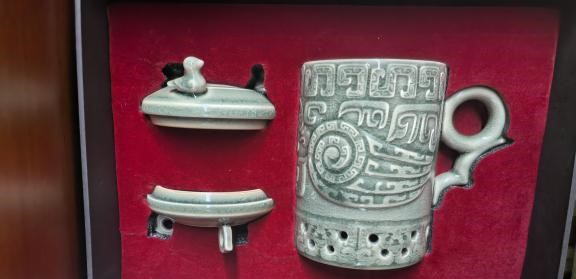
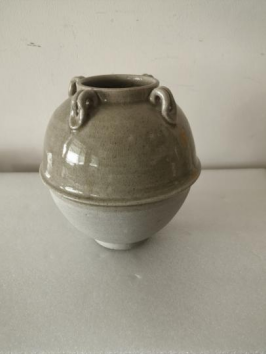
The ware used local clay, high in aluminum and low in silicon, typically coarse and greyish, though finer wares existed. Glaze, applied inside and partially outside, often stopped short of the base. Iron oxide (over 1%) as the main colorant produced glazes ranging from pea-green and grey-green to yellowish-white, with a glassy luster and fine crackle. Kiln tools like single and tripod supports left clear stacking marks on bowls and plates, while jars and bottles were fired singly. Decoration primarily involved incised concentric lines, with finer pieces featuring motifs like lotus petals and scrolling vines.
Analysis confirms that porcelain from Sui tombs in Xiaotun and elsewhere in Anyang matches Xiangzhou Kiln finds, confirming their origin. Like the famous Yinxu site, the Xiaotun Sui tombs witnessed the development of Chinese archaeology. Their porcelain, largely from the Xiangzhou Kiln, is an excellent representative of early northern celadon. Some vessels, approaching white porcelain, mark a key technological breakthrough that profoundly influenced the Tang and Song ceramics industry.
Gallery